

Puzzle hobbies offer a fantastic way to reduce anxiety while sharpening your mental focus. You can try jigsaw puzzles for methodical engagement, crosswords to boost vocabulary, or Sudoku for logical thinking. The Rubik's Cube enhances spatial awareness, while word searches provide a relaxing challenge. Logic puzzles and cryptograms improve problem-solving skills, and mazes offer a meditative experience. 3D mechanical puzzles provide tactile stimulation, and tangrams develop spatial reasoning. These activities not only calm your mind but also improve cognitive abilities. Explore these options to discover which puzzle type resonates most with your anxiety-relief needs.
Jigsaw Puzzles
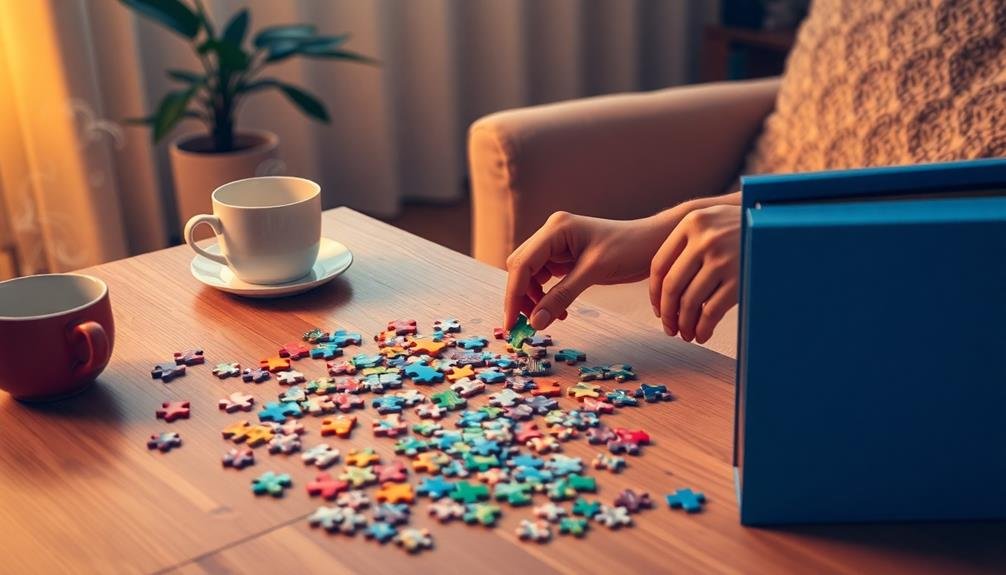
Jigsaw puzzles' methodical nature makes them an excellent anxiety-reducing hobby. As you focus on fitting pieces together, your mind shifts away from worries and onto the task at hand. This meditative process can help lower stress levels and promote a sense of calm.
Start by choosing a puzzle that appeals to you, whether it's a scenic landscape, a famous artwork, or an abstract design. Find a comfortable space to work on your puzzle, ensuring good lighting and a flat surface. As you sort the pieces by color or pattern, you're already engaging in a soothing, organizational activity.
Working on a jigsaw puzzle improves your concentration and problem-solving skills. You'll develop strategies for tackling different sections, enhancing your spatial awareness and cognitive abilities. The satisfaction of completing a puzzle can boost your self-esteem and provide a sense of accomplishment.
You can make puzzling a social activity by inviting friends or family to join you. This shared experience can strengthen bonds and create a relaxing atmosphere.
Alternatively, enjoy the solitude of puzzling alone as a form of self-care and mindfulness practice.
Crosswords
Word enthusiasts find solace in crosswords, another anxiety-busting puzzle hobby. These linguistic challenges offer a perfect blend of mental stimulation and relaxation. As you fill in the grid with letters, you'll find your mind focusing solely on deciphering clues and recalling vocabulary, effectively pushing anxiety to the background.
You don't need fancy equipment to enjoy crosswords; a newspaper, pen, and your brain are all that's required. Start with easier puzzles and gradually increase difficulty as your skills improve. You'll discover that crosswords enhance your vocabulary, improve your general knowledge, and sharpen your problem-solving abilities.
To maximize the anxiety-reducing benefits, create a calm environment for solving. Find a quiet spot, brew a cup of tea, and settle in for some wordplay. Don't rush; take your time with each clue. If you're stuck, move on and return later with fresh eyes. Remember, it's not about speed but enjoyment and mental engagement.
Consider joining online crossword communities or subscribing to puzzle magazines for a steady supply of new challenges. You'll soon find that crosswords become a rewarding daily ritual, offering a welcome respite from stress and anxiety.
Sudoku
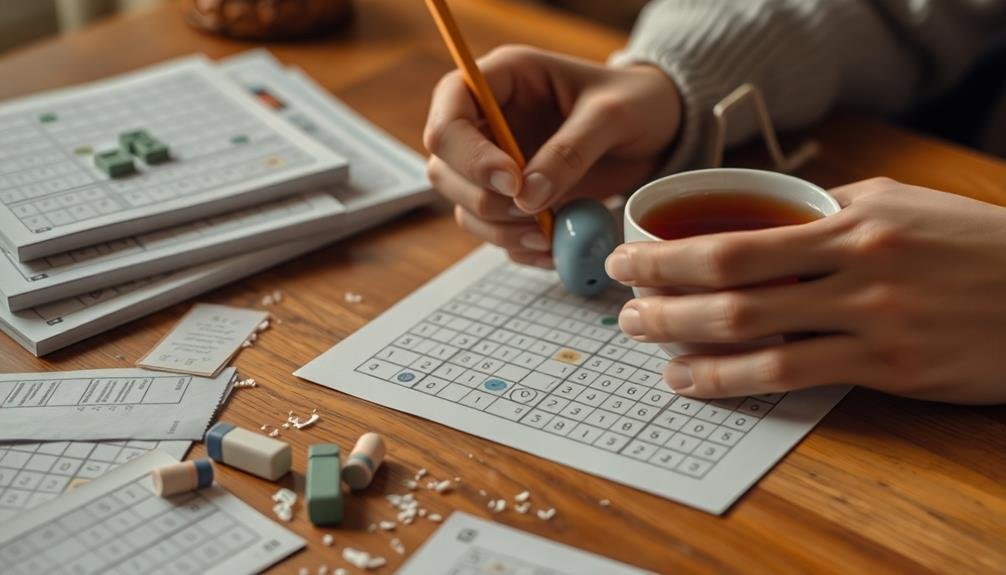
For those who prefer numbers over words, Sudoku offers an engaging alternative in the domain of anxiety-reducing puzzles. This Japanese-origin game challenges you to fill a 9×9 grid with digits so that each column, row, and 3×3 sub-grid contains all numbers from 1 to 9. As you focus on solving the puzzle, your mind naturally shifts away from anxious thoughts.
You'll find Sudoku puzzles ranging from beginner to expert levels, allowing you to progress as your skills improve. The game's logical nature helps sharpen your critical thinking and problem-solving abilities while providing a sense of accomplishment with each completed grid.
Regular Sudoku practice can enhance your concentration and memory, potentially benefiting other areas of your life.
To get started, grab a Sudoku book or download a mobile app. Set aside dedicated time for puzzle-solving, creating a calming ritual in your daily routine.
As you immerse yourself in the world of numbers and patterns, you'll likely experience a meditative state that can considerably reduce stress and anxiety. Remember, the goal isn't just to complete the puzzle but to enjoy the process and reap the mental health benefits along the way.
Rubik's Cube
You'll find that solving a Rubik's Cube challenges your logical thinking as you work out the steps to align all sides.
As you practice, you'll develop better color pattern recognition, quickly identifying and matching the cube's various hues.
Your hand-eye coordination will improve too, as you learn to manipulate the cube swiftly and precisely.
Logical Thinking Development
Through the colorful chaos of a Rubik's Cube, you'll find a gateway to enhanced logical thinking. As you twist and turn the cube, you're not just solving a puzzle; you're rewiring your brain to think more systematically. Each move requires you to evaluate its consequences, forcing you to plan several steps ahead.
You'll develop pattern recognition skills as you learn to identify specific color arrangements and their relationships. This ability transfers to other areas of life, helping you spot trends and make connections more easily.
The cube also enhances your spatial awareness, improving your ability to visualize and manipulate objects in your mind. As you progress, you'll learn various algorithms – sequences of moves that achieve specific outcomes. This process strengthens your memory and ability to apply abstract concepts to concrete problems.
You'll also cultivate patience and persistence, vital traits for problem-solving in any context. The Rubik's Cube isn't just a toy; it's a tool for cognitive development.
Color Pattern Recognition
Have you ever marveled at how Rubik's Cube masters seem to solve the puzzle in mere seconds? Their ability to recognize color patterns and quickly manipulate the cube is a skill that you can develop too.
Practicing with a Rubik's Cube enhances your color pattern recognition, spatial awareness, and problem-solving abilities.
As you engage with this classic puzzle, you'll experience:
- Improved visual processing
- Enhanced short-term memory
- Increased hand-eye coordination
- Better concentration and focus
- Reduced stress and anxiety
Start by learning the basic algorithms and color relationships. You'll soon find yourself recognizing patterns more quickly and developing strategies to solve the cube efficiently.
Don't be discouraged if it takes time; even experts began as beginners.
Regular practice with the Rubik's Cube can sharpen your mind and provide a satisfying sense of accomplishment.
As you progress, you might even discover new solving techniques or participate in speed-cubing competitions. This engaging hobby not only challenges your brain but also offers a fun way to unwind and redirect anxious energy into a productive, mindful activity.
Hand-Eye Coordination Improvement
The Rubik's Cube's intricate twists and turns offer more than just a mental challenge; they're a playground for your hands and eyes to work in harmony. As you manipulate the cube, you're constantly tracking the movement of colors and patterns while your fingers execute precise rotations. This simultaneous engagement of visual processing and fine motor skills hones your hand-eye coordination.
Regular practice with the Rubik's Cube can improve your spatial awareness and dexterity. You'll notice enhanced finger agility as you learn to perform faster turns and develop muscle memory for common solving algorithms.
The cube's tactile nature also stimulates your sense of touch, making you more aware of subtle differences in texture and pressure.
As your skills improve, you'll find yourself solving the cube with increasing speed and accuracy. This progress not only boosts your confidence but also translates to other activities requiring hand-eye coordination, such as typing, playing musical instruments, or even sports.
The Rubik's Cube acts as a portable gym for your brain and hands, offering a fun and engaging way to sharpen your motor skills while reducing anxiety through focused, purposeful movement.
Word Search

For decades, word search puzzles have captivated puzzle enthusiasts with their deceptively simple premise. You'll find yourself scanning a grid of letters, searching for hidden words that may run horizontally, vertically, or diagonally. As you focus on finding each word, you'll notice your anxiety melting away, replaced by a sense of accomplishment with each discovery.
Word search puzzles offer a unique blend of relaxation and mental stimulation. They're perfect for:
- Unwinding after a long day
- Improving your concentration
- Enhancing your pattern recognition skills
- Building vocabulary
- Providing a sense of achievement
You'll find that word searches come in various difficulty levels, from beginner to expert. As you progress, you'll encounter more challenging puzzles with longer words, reverse spellings, and even themed searches.
You can start with printed puzzles or explore digital versions on your smartphone or tablet for on-the-go entertainment.
Regular word search practice can sharpen your cognitive abilities while providing a calming distraction from daily stressors. It's an accessible hobby that requires minimal equipment and can be enjoyed anywhere, making it an ideal choice for anxiety relief and mental focus.
Tangrams
Originating in ancient China, tangrams challenge you to arrange seven geometric shapes into specific patterns.
You'll exercise your problem-solving skills as you manipulate triangles, squares, and parallelograms to form animals, objects, and abstract designs.
Ancient Chinese Puzzle Origins
Chinese ingenuity gave birth to one of the world's most enduring puzzle games: the tangram. Dating back to the Tang Dynasty (618-907 AD), this ancient puzzle consists of seven geometric shapes that can be arranged to form countless figures.
You'll find its origins shrouded in mystery, with various legends attributing its creation to different historical figures. The tangram's popularity soared during the 19th century, spreading from China to Europe and America.
As you explore this fascinating puzzle, you'll discover its rich history and cultural significance. The game's simplicity and versatility have made it a timeless favorite for both children and adults.
When you engage with tangrams, you'll experience:
- Enhanced spatial awareness
- Improved problem-solving skills
- Increased creativity and imagination
- Stress relief and relaxation
- A deeper appreciation for geometry
Today, you can find tangrams in various forms, from traditional wooden sets to digital apps. As you manipulate the pieces, you're not just solving a puzzle but also connecting with centuries of Chinese tradition and mathematical ingenuity.
This ancient game continues to challenge and delight puzzle enthusiasts worldwide, proving that sometimes the simplest concepts can yield the most enduring and engaging pastimes.
Shapes and Problem-Solving Skills
As you explore the world of tangrams, you'll quickly discover how these simple shapes can sharpen your problem-solving skills. This ancient Chinese puzzle consists of seven flat pieces called tans: five triangles, one square, and one parallelogram. Your challenge is to arrange these pieces to form specific shapes or silhouettes.
Tangrams engage your spatial reasoning and creativity as you manipulate the pieces to fit various configurations. You'll find yourself rotating, flipping, and repositioning the tans to solve each puzzle. This process enhances your ability to visualize and mentally manipulate objects, skills that are valuable in many real-world applications.
As you progress, you'll encounter increasingly complex shapes that require more advanced problem-solving strategies. You'll learn to break down larger problems into smaller, manageable parts and develop systematic approaches to puzzle-solving. These skills can translate to other areas of your life, helping you tackle complex issues with greater ease and confidence.
Tangrams also offer a meditative quality, allowing you to focus intently on the task at hand and temporarily set aside other worries. This mental engagement can provide a welcome respite from anxiety and stress, making tangrams an excellent choice for relaxation and mental stimulation.
Logic Puzzles
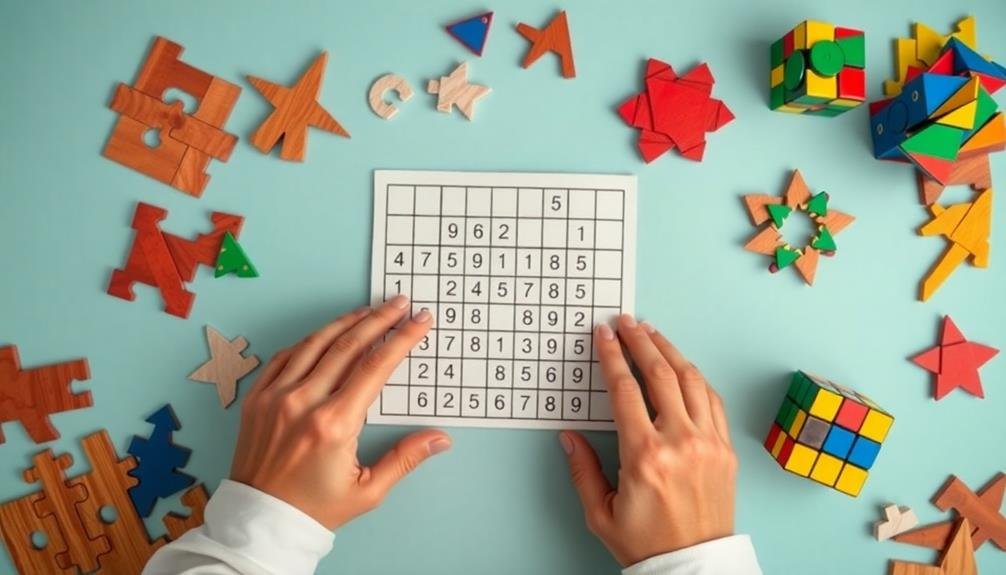
Many logic puzzles challenge your deductive reasoning skills while providing a soothing distraction from anxious thoughts. These brain teasers come in various forms, from classic grid-based puzzles to more complex narrative riddles. As you engage with logic puzzles, you'll find yourself fully immersed in the problem-solving process, temporarily setting aside worries and focusing on the task at hand.
Logic puzzles offer a structured approach to problem-solving, which can be particularly comforting when you're feeling overwhelmed. You'll typically work through a series of clues, eliminating possibilities and drawing conclusions based on the given information. This methodical process can help calm your mind and restore a sense of order.
Some popular types of logic puzzles include:
- Sudoku
- Nonograms (also known as Picross)
- Einstein's Riddles
- Logic Grid Puzzles
- Cryptograms
As you progress in your puzzle-solving skills, you'll likely notice improvements in your critical thinking abilities and overall mental acuity. This can boost your confidence and provide a sense of accomplishment, further helping to alleviate anxiety.
Cryptograms
Cryptograms challenge your mind while offering a fun escape from anxiety. These puzzles present encoded messages where each letter is substituted with another, creating a secret code for you to crack. As you decipher the hidden text, you'll engage in a mental workout that sharpens your problem-solving skills and boosts your concentration.
To solve a cryptogram, you'll start by identifying common patterns and letter frequencies. Look for short words like "a" and "the," which can provide valuable clues. As you progress, you'll develop strategies to recognize recurring letter combinations and word structures. This process of pattern recognition and logical deduction can help quiet anxious thoughts by redirecting your focus to the puzzle at hand.
You'll find cryptograms in various difficulty levels, from beginner-friendly to expert challenges. Many newspapers and puzzle books feature daily cryptograms, while online platforms offer a wealth of options to suit your skill level.
As you improve, you might even try creating your own cryptograms, adding another layer of creativity to this engaging hobby. By immersing yourself in the world of cryptograms, you'll discover a rewarding and anxiety-reducing pastime that keeps your mind sharp and entertained.
Mazes
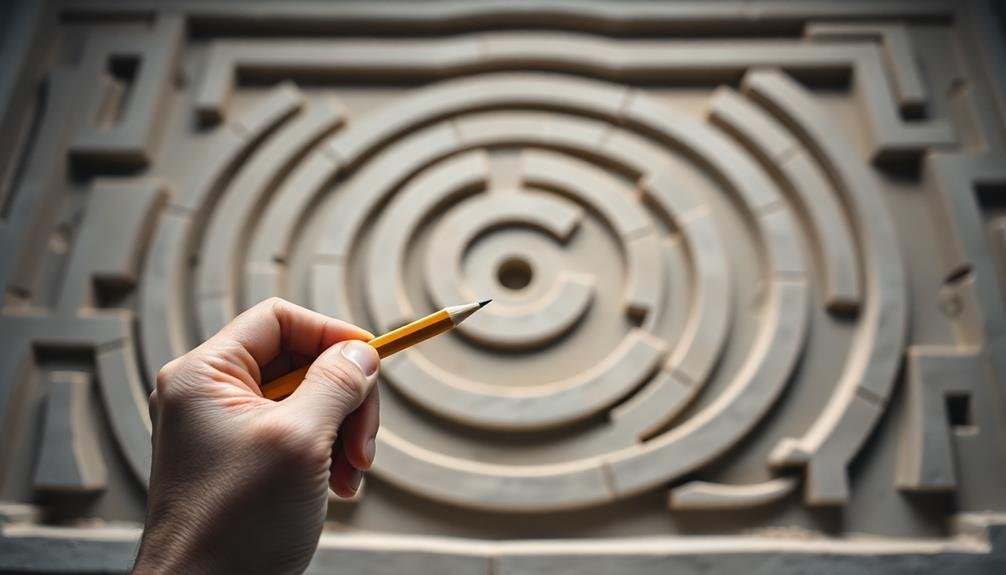
Within the domain of anxiety-busting puzzles, mazes offer a unique and soothing challenge. As you trace your path through intricate designs, you're engaging in a mindful activity that demands focus and patience. Mazes come in various forms, from simple paper-based puzzles to complex digital labyrinths, catering to all skill levels and preferences.
When you immerse yourself in a maze, you'll experience:
- A sense of accomplishment as you progress
- Improved problem-solving skills
- Enhanced spatial awareness
- Reduced stress and anxiety
- Increased concentration and mental clarity
Solving mazes isn't just about reaching the end; it's about the journey. You'll find yourself fully absorbed in the present moment, temporarily forgetting your worries. This meditative quality makes mazes an excellent tool for managing anxiety and promoting relaxation.
To get started, you can find maze books at your local bookstore or download maze apps on your smartphone.
As you advance, you might even try creating your own mazes, adding another layer of creativity to this calming hobby. Remember, there's no rush – take your time and enjoy the process of unraveling each maze's mystery.
3D Mechanical Puzzles
For those seeking a hands-on anxiety-busting experience, 3D mechanical puzzles offer an enthralling challenge. These intricate devices come in various forms, from classic wooden burr puzzles to modern metal disentanglement puzzles. As you manipulate the pieces, your mind becomes fully engaged in problem-solving, effectively pushing anxious thoughts aside.
You'll find that 3D mechanical puzzles range in difficulty, allowing you to start with simpler designs and progress to more complex ones as your skills improve. Some popular types include the Rubik's Cube, tangrams, and interlocking puzzles. The tactile nature of these puzzles can be particularly soothing, as you focus on the feel of the pieces in your hands.
Many enthusiasts enjoy collecting different puzzles, creating a diverse array of challenges to tackle. You can even join online communities to share solving techniques and discover new puzzles.
As you work through each puzzle, you'll experience a sense of accomplishment that can boost your confidence and reduce stress. Remember, the goal isn't always to solve the puzzle quickly, but to enjoy the process and give your mind a break from anxiety.
Frequently Asked Questions
How Do Puzzle Hobbies Affect Brain Plasticity and Cognitive Function?
You'll boost your brain plasticity and cognitive function through puzzle hobbies. They'll challenge your mind, form new neural connections, and improve problem-solving skills. You'll enhance memory, attention, and spatial reasoning while keeping your brain active and engaged.
Can Puzzle-Solving Skills Transfer to Real-Life Problem-Solving Situations?
Yes, puzzle-solving skills can transfer to real-life problem-solving. You'll develop critical thinking, pattern recognition, and persistence. These abilities will help you approach complex issues methodically, consider multiple solutions, and stay focused on finding answers in everyday situations.
Are There Age-Specific Puzzle Recommendations for Optimal Cognitive Benefits?
Yes, there are age-specific puzzle recommendations for ideal cognitive benefits. You'll find simpler puzzles for children, while adults can tackle more complex challenges. As you age, you should choose puzzles that match your cognitive abilities and interests.
What Role Do Puzzle Hobbies Play in Preventing Cognitive Decline?
Puzzle hobbies can greatly slow cognitive decline. They'll challenge your brain, improving memory and problem-solving skills. You'll boost mental flexibility and concentration. Regular puzzle-solving may even reduce your risk of developing dementia or Alzheimer's disease.
How Do Digital Puzzle Apps Compare to Traditional Puzzles for Anxiety Reduction?
Digital puzzle apps offer convenience and variety, but they can't match the tactile experience of traditional puzzles. You'll find that physical puzzles provide a more immersive, screen-free escape that's often better for reducing anxiety and promoting relaxation.
In Summary
You've now got a toolkit of engaging puzzle hobbies to help calm your mind and sharpen your focus. Whether you're piecing together a jigsaw or cracking a cryptogram, you'll find these activities offer a welcome distraction from daily stressors. Don't hesitate to try different puzzles until you find your favorites. Remember, it's not just about solving the puzzle; it's about giving your brain a workout and your anxiety a break. Enjoy the challenge and reap the mental benefits!

Leave a Reply