

Brain teasers offer a fun and effective way to boost your mental health and cognitive abilities. You'll find a wide variety of puzzles to suit your interests, from classic word games like crosswords to number challenges like Sudoku. Visual illusions and hidden object games can sharpen your perception, while physical puzzles engage both mind and hands. Digital apps make it easy to incorporate brain training into your daily routine, offering gamified experiences that keep you motivated. By regularly challenging your brain with these puzzles, you'll not only find moments of peace but also potentially improve your memory, problem-solving skills, and overall cognitive function. Discover how these mental workouts can transform your mind.
The Science Behind Brain Teasers

While brain teasers may seem like mere entertainment, they're actually powerful tools for cognitive development. When you engage with these puzzles, you're activating various areas of your brain, including those responsible for problem-solving, critical thinking, and creativity. Neuroscientists have found that solving brain teasers can increase neural connections, effectively rewiring your brain for improved cognitive function.
As you work through a challenging puzzle, your brain releases dopamine, a neurotransmitter associated with pleasure and motivation. This chemical reward encourages you to continue solving puzzles, creating a positive feedback loop that enhances your learning and memory retention. Additionally, brain teasers often require you to approach problems from multiple angles, fostering mental flexibility and adaptability.
Regular exposure to brain teasers can lead to long-term cognitive benefits. Studies have shown that individuals who frequently engage in puzzles and mental exercises have a lower risk of developing neurodegenerative diseases like Alzheimer's.
Furthermore, these activities can help maintain cognitive function as you age, keeping your mind sharp and agile. By incorporating brain teasers into your daily routine, you're not just having fun – you're actively investing in your brain's health and longevity.
Classic Word Puzzles
When it comes to brain teasers, classic word puzzles have stood the test of time. These linguistic challenges have entertained and educated people for generations, sharpening minds and expanding vocabularies. You'll find a wide variety of word puzzles to suit your tastes and skill level.
Crosswords reign supreme in this category, offering a grid of intersecting words based on clever clues. You'll need to think laterally and draw on your general knowledge to complete these popular puzzles.
Anagrams challenge you to rearrange letters to form new words or phrases, testing your ability to see patterns and possibilities. Word searches, while simpler, still require focus and attention to detail as you hunt for hidden words in a sea of letters.
For a more cerebral challenge, try cryptic crosswords. These puzzles use wordplay and misdirection in their clues, demanding a combination of lateral thinking and linguistic prowess.
Acrostics offer a unique twist, where the first letters of solved clues spell out a quotation or message. Whatever your preference, classic word puzzles provide an engaging way to exercise your brain and expand your linguistic skills.
Number and Logic Games
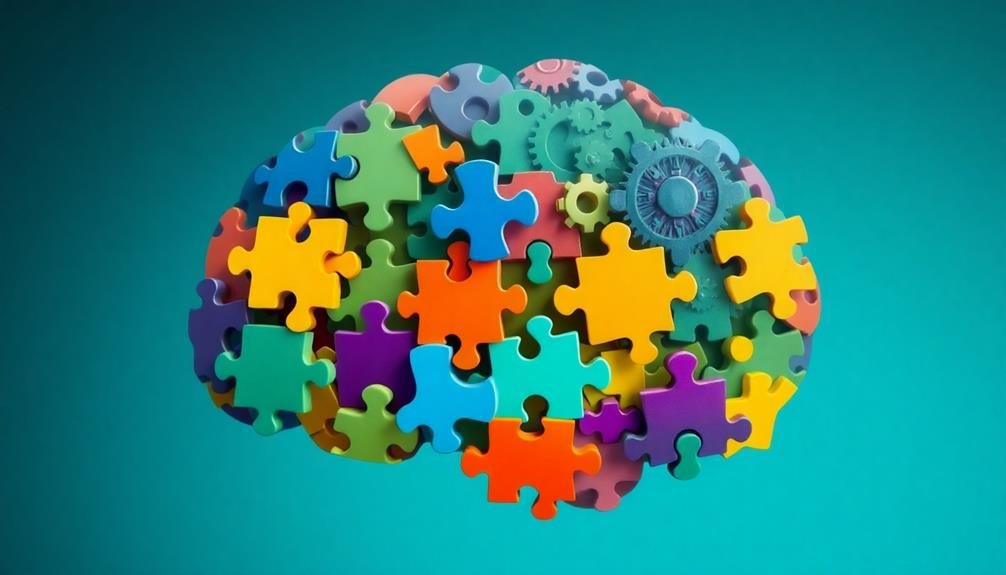
Number and logic games offer a different flavor of mental challenge. These puzzles require you to flex your mathematical and analytical muscles, often presenting you with a set of rules or constraints that you must navigate to find the solution. Popular examples include Sudoku, where you'll fill a 9×9 grid with numbers following specific rules, and KenKen, which adds arithmetic operations to the mix.
You'll also encounter logic grid puzzles, where you're given a set of clues to deduce relationships between different categories. These games sharpen your deductive reasoning skills and teach you to organize information systematically.
For a more number-focused challenge, try Kakuro, a crossword-like puzzle using numbers instead of letters.
Don't overlook classic number sequences and patterns. You'll need to identify the underlying rule to complete these series, exercising your pattern recognition abilities.
Logic games like the Tower of Hanoi or the Missionaries and Cannibals problem will push your problem-solving skills to new heights. As you tackle these puzzles, you'll find your analytical thinking improving, benefiting you in various aspects of life beyond just solving brain teasers.
Visual Brain Teasers
Visual brain teasers offer a fascinating challenge to your perception and focus.
You'll encounter mind-bending optical illusions that test your ability to interpret visual information accurately.
Hidden object puzzles will sharpen your observational skills as you search for concealed items within complex images.
Optical Illusions Challenge Perception
Optical illusions mess with your mind, challenging what you think you're seeing. These visual tricks exploit the way your brain processes information, creating discrepancies between perception and reality. You'll find yourself doubting your own eyes as you encounter images that seem to move, change color, or transform before you.
Classic examples like the Necker cube and the Rubin vase demonstrate how your brain can interpret ambiguous images in multiple ways. The Müller-Lyer illusion tricks you into perceiving lines of equal length as different sizes, while the Ponzo illusion manipulates your sense of perspective.
You'll be amazed by the Ames room, where people appear to shrink or grow as they move across the space.
More complex illusions, such as impossible objects like the Penrose triangle, challenge your understanding of three-dimensional space. Motion illusions like the rotating snakes create the sensation of movement in static images.
As you explore these visual puzzles, you'll gain insight into the fascinating workings of your visual system and the intricate relationship between your eyes and brain. Optical illusions not only entertain but also reveal the limitations and adaptability of human perception.
Hidden Objects Sharpen Focus
Hidden object puzzles challenge your visual acuity and concentration in unique ways. These brain teasers require you to scan complex images, hunting for specific items amid a sea of distractions. As you search, you're training your brain to filter information and focus on relevant details.
You'll find hidden object puzzles in various formats, from traditional printed books to digital apps and online games. They often feature intricate scenes with dozens or hundreds of items cleverly concealed within the image. Your task is to locate and identify a list of objects, which can range from everyday items to bizarre and unexpected things.
Engaging with these puzzles regularly can improve your attention to detail, visual processing speed, and short-term memory. You'll learn to quickly scan and analyze complex visual information, a skill that's valuable in many real-life situations.
Hidden object games also offer a meditative experience, allowing you to immerse yourself in a focused task and temporarily escape daily stresses.
To maximize the benefits, try timed challenges or compete with friends. This adds an element of excitement and pushes you to sharpen your skills even further.
Physical Puzzle Challenges
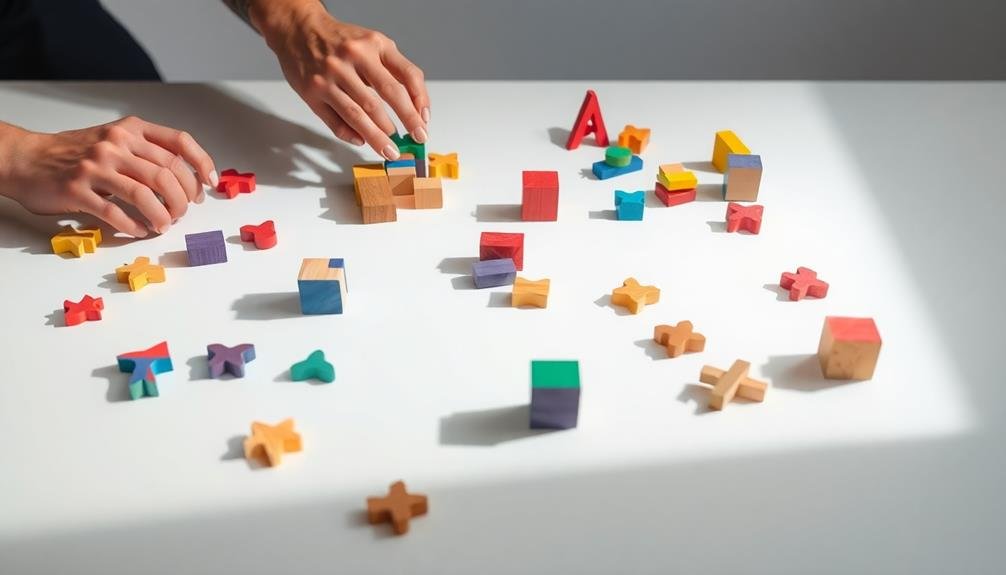
Physical puzzle challenges engage your mind and hands simultaneously, offering a tangible twist on traditional brain teasers. These three-dimensional puzzles come in various forms, from classic Rubik's Cubes to intricate wooden boxes with hidden compartments. As you manipulate the pieces, you'll develop spatial reasoning skills and improve your problem-solving abilities.
One popular type is the disentanglement puzzle, where you must separate interlocked metal or wooden pieces. These require patience and logical thinking to understand how the components interact.
Another category is assembly puzzles, like the Soma cube, which challenge you to construct specific shapes from smaller pieces.
Mechanical puzzles, such as combination locks or puzzle boxes, often involve discovering hidden mechanisms. You'll need to observe closely and think creatively to uncover the solution. Some physical puzzles even incorporate elements of optical illusions or mathematical concepts, adding extra layers of complexity.
Don't underestimate the value of these hands-on challenges. They can enhance your fine motor skills, boost your concentration, and provide a satisfying sense of accomplishment when solved.
Whether you're a beginner or an experienced puzzler, there's a physical brain teaser out there to challenge and entertain you.
Digital Brain Training Apps
You'll find a wealth of digital brain training apps designed to sharpen your cognitive skills through engaging puzzles and games.
These apps often employ gamification techniques to make learning more enjoyable, rewarding your progress with points, badges, or levels as you tackle increasingly difficult challenges.
While the long-term cognitive benefits of these apps are still being researched, many users report improvements in areas like memory, attention, and problem-solving skills.
Popular App Recommendations
Digital brain training apps have surged in popularity, offering convenient ways to challenge your mind and sharpen cognitive skills. If you're looking to boost your mental acuity, consider these top-rated options:
Lumosity stands out with its diverse array of games targeting memory, attention, and problem-solving. It adapts to your performance, ensuring you're always challenged.
Elevate focuses on improving communication skills alongside cognitive abilities, featuring exercises in writing, listening, and math.
Peak offers a sleek interface and games designed by neuroscientists, emphasizing focus, memory, and mental agility.
For puzzle enthusiasts, Unblock Me presents increasingly complex sliding block challenges, enhancing spatial reasoning.
Sudoku.com provides a vast collection of number puzzles at various difficulty levels, perfect for logic training.
If you prefer word games, Words with Friends combines social interaction with vocabulary expansion.
CogniFit takes a more scientific approach, offering detailed cognitive assessments and personalized training programs.
Gamification of Learning
The rise of digital brain training apps has ushered in a new era of gamified learning. These apps transform mundane cognitive exercises into engaging, interactive experiences that keep you coming back for more. By incorporating game-like elements such as points, levels, and rewards, they tap into your natural desire for achievement and progress.
You'll find a wide array of brain training apps that target different cognitive skills. Some focus on memory enhancement, challenging you to recall sequences or patterns. Others hone your problem-solving abilities through increasingly complex puzzles. Many apps offer a mix of exercises, providing a well-rounded mental workout.
The beauty of these gamified learning tools lies in their accessibility and convenience. You can train your brain anytime, anywhere, with just a few minutes to spare. Regular use can potentially improve your cognitive function, reaction time, and mental agility.
However, it's important to approach brain training apps with realistic expectations. While they can be fun and potentially beneficial, they're not a magic solution for cognitive decline.
Combine them with a healthy lifestyle, including proper sleep, exercise, and social interaction, for peak brain health.
Cognitive Benefits Explored
While the jury's still out on the long-term effectiveness of digital brain training apps, research suggests they may offer some cognitive benefits. These apps often incorporate puzzles and games designed to challenge your mind, potentially improving various aspects of cognitive function.
When you regularly engage with brain training apps, you're exercising your mental muscles. This consistent cognitive workout may lead to improvements in:
- Memory: Both short-term and working memory might be enhanced through specific memory-based exercises.
- Problem-solving skills: Puzzles and logic games can sharpen your ability to think critically and find solutions.
- Processing speed: Timed challenges may help you process information more quickly and efficiently.
You'll find a wide variety of brain training apps available, each focusing on different cognitive domains. Some target attention span, while others emphasize spatial reasoning or language skills.
Incorporating Puzzles Into Daily Routine
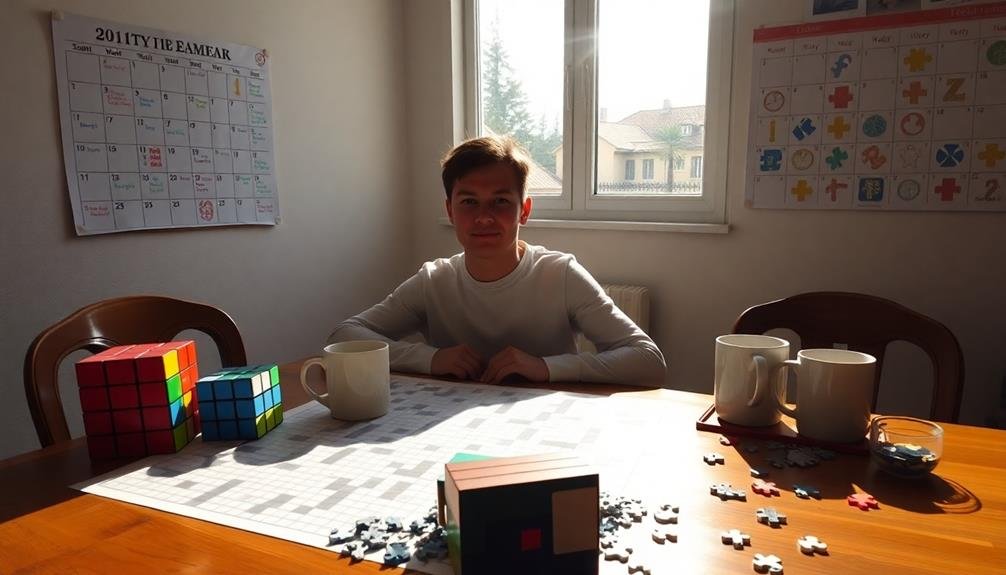
Busy professionals often struggle to find time for mental exercises, but incorporating puzzles into your daily routine doesn't have to be a challenge. Start by setting aside a few minutes during your morning coffee or commute to tackle a quick crossword or Sudoku puzzle.
You can also use your lunch break to solve riddles or logic problems, which can help refresh your mind for the afternoon's tasks. Consider downloading puzzle apps on your smartphone, allowing you to engage in brain teasers whenever you have a spare moment.
During conference calls or while waiting for appointments, you can silently work on number games or word puzzles. Before bed, try solving a jigsaw puzzle or playing a round of solitaire to unwind and exercise your mind simultaneously.
Make puzzles a social activity by challenging coworkers or family members to solve brain teasers together. This can foster teamwork and create a fun, competitive atmosphere.
Don't forget to vary the types of puzzles you engage with to target different cognitive skills. By seamlessly integrating these mental exercises into your daily life, you'll reap the benefits of improved cognitive function without sacrificing your busy schedule.
Frequently Asked Questions
Are Brain Teasers Suitable for All Age Groups?
Brain teasers can be suitable for all age groups. You'll find puzzles tailored to different skill levels and interests. They're great for kids, adults, and seniors alike. You can choose ones that match your abilities and preferences.
How Long Should One Spend on Brain Teasers Daily?
You should spend about 15-30 minutes daily on brain teasers. It's enough to challenge your mind without overwhelming you. If you're enjoying it, feel free to extend your time. Don't stress if you can't solve everything immediately.
Can Brain Teasers Help With Specific Learning Disabilities?
Yes, brain teasers can help with specific learning disabilities. You'll find they improve your problem-solving skills, memory, and concentration. They're particularly beneficial for dyslexia, ADHD, and processing disorders. Try incorporating them into your daily routine for best results.
Are There Cultural Differences in Brain Teaser Preferences?
You'll find cultural differences in brain teaser preferences. What's popular in one country might not be in another. Your cultural background can influence which puzzles you enjoy, as they often reflect local traditions, language, and thinking styles.
Do Brain Teasers Have Any Negative Effects on Mental Health?
You shouldn't worry too much about brain teasers harming your mental health. They're generally beneficial, but if you find them frustrating or stressful, it's okay to take breaks. Moderation is key in any mental activity.
In Summary
You've now explored a variety of brain teasers that'll challenge your mind and bring a sense of peace. Whether you prefer word puzzles, number games, visual challenges, or physical puzzles, there's something for everyone. Don't forget to check out digital apps for on-the-go brain training. By incorporating these puzzles into your daily routine, you'll keep your mind sharp and reduce stress. So go ahead, pick your favorite puzzle type and start exercising your brain today!


Leave a Reply