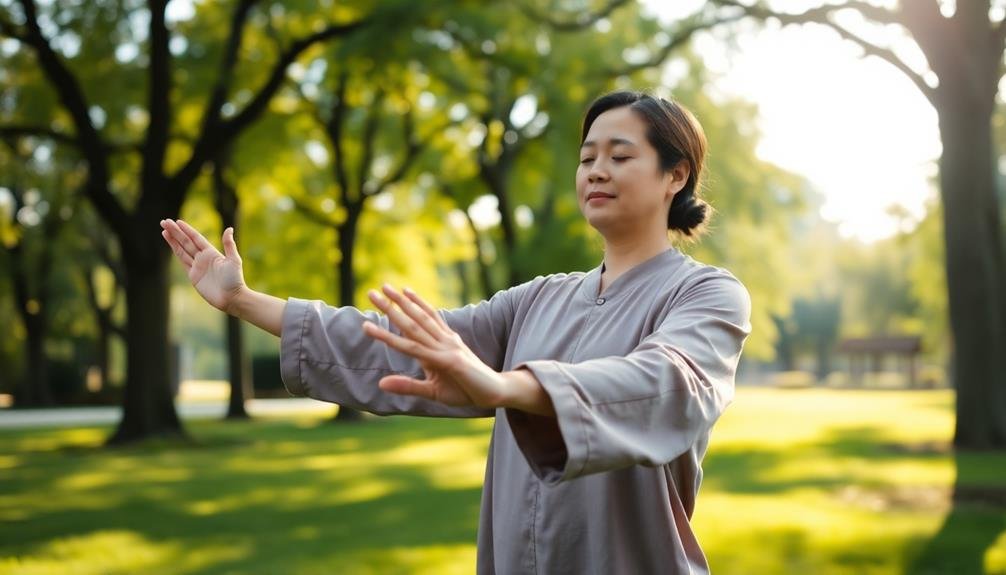
Qigong offers several powerful moves to melt away everyday stress. You can start with "Standing Like a Tree" to ground yourself and enhance stability. "Butterfly Stretch" releases tension in your lower back and hips, while "Shaking the Tree" invigorates your body and mind. "White Crane Spreads Its Wings" targets shoulder and neck tension, and "Smiling Heart Meditation" cultivates inner peace. "Lotus Rises Through Water" combines controlled breathing with arm motions for renewal. The "Five Elements Qigong" harmonizes your energy, and "Golden Ball of Light" helps direct healing energy. These accessible techniques can quickly restore balance and calm to your daily life. Discover how these moves can transform your stress management routine.
Standing Like a Tree
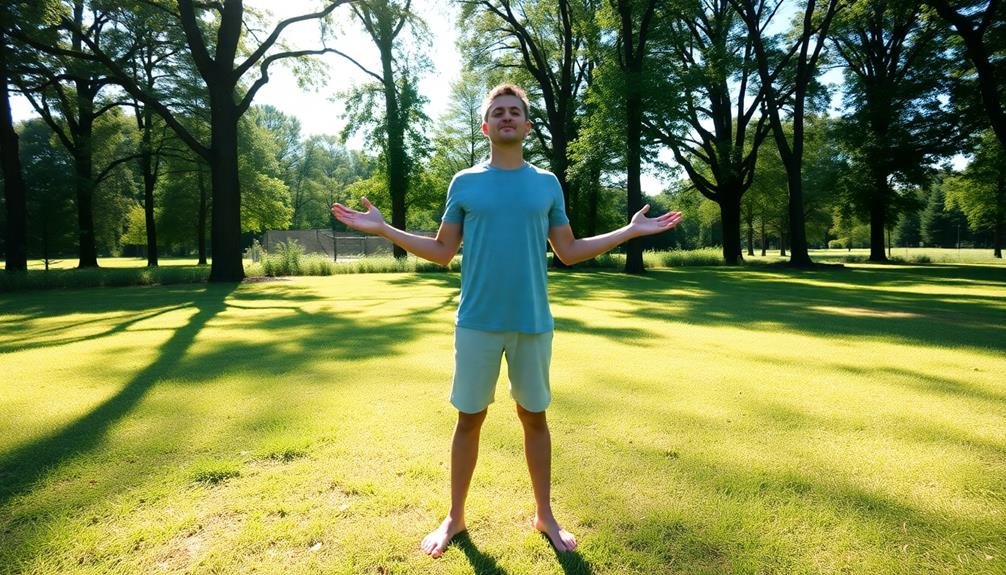
The tree-like posture of this Qigong move offers a grounding experience for practitioners. To perform Standing Like a Tree, start by placing your feet shoulder-width apart, with your knees slightly bent. Relax your shoulders and let your arms hang naturally at your sides. Imagine roots growing from your feet, anchoring you to the earth.
Next, raise your arms as if you're hugging a large tree, keeping your elbows slightly bent. Your palms should face your body, with fingertips pointing toward each other. Maintain this position for 5-10 minutes, focusing on your breath and feeling the energy flow through your body.
As you hold the pose, visualize yourself as a sturdy tree, withstanding the winds of stress and change. This practice helps improve posture, balance, and overall body awareness. It also strengthens your legs and core while promoting a sense of calm and stability.
Remember to breathe deeply and evenly throughout the exercise. If you feel discomfort, adjust your stance slightly or lower your arms.
With regular practice, you'll find this Qigong move becomes easier and more effective at melting away everyday stress.
Eight Pieces of Brocade
One of the most renowned Qigong practices, the Eight Pieces of Brocade, offers an extensive set of movements to enhance your overall well-being. This sequence consists of eight distinct exercises, each targeting specific areas of your body and mind.
You'll find that these movements are designed to improve your flexibility, strength, and balance while reducing stress and anxiety.
To begin, stand with your feet shoulder-width apart and take a few deep breaths. The first movement involves lifting your hands to the sky, followed by bending to touch your toes. Next, you'll rotate your torso, massage your kidneys, and perform a punching motion.
The sequence continues with stretching your legs, shaking your body, and concluding with a deep squat.
As you practice the Eight Pieces of Brocade, focus on your breath and maintain a relaxed, yet engaged posture. You'll notice improvements in your energy levels, digestion, and overall mood with regular practice.
Remember to move slowly and deliberately, allowing yourself to fully experience each movement's benefits. By incorporating this Qigong sequence into your daily routine, you'll cultivate a sense of calm and liveliness that carries you through life's challenges.
Butterfly Stretch
The Butterfly Stretch is a simple yet effective Qigong move that can help release tension in your lower back and hips.
You'll sit on the floor with the soles of your feet together, gently pressing your knees towards the ground while maintaining a straight spine.
As you practice this stretch, focus on deep, rhythmic breathing to enhance its stress-relieving benefits and make certain you're not overextending your muscles.
Technique and Benefits
Let's explore the Butterfly Stretch, a simple yet effective Qigong move that can help melt away stress.
To perform this technique, sit on the floor with your back straight and bring the soles of your feet together in front of you. Hold your feet with your hands and gently pull them towards your body. Allow your knees to drop towards the floor, creating a diamond shape with your legs.
As you hold this position, focus on your breath. Inhale deeply through your nose, feeling your belly expand. Exhale slowly through your mouth, releasing tension from your hips and inner thighs. You can enhance the stretch by gently pressing your knees down with your elbows.
The Butterfly Stretch offers numerous benefits. It helps release tension in your lower back, hips, and groin area. This move improves flexibility in your hip joints and inner thighs, promoting better posture and reducing lower back pain.
It's also known to stimulate your root chakra, which can help ground you and reduce anxiety. By combining this stretch with mindful breathing, you'll activate your parasympathetic nervous system, promoting relaxation and stress relief.
Proper Form Tips
While performing the Butterfly Stretch, it's critical to maintain proper form to maximize its benefits and prevent injury. Start by sitting on the floor with your back straight and your feet together, soles touching. Draw your heels as close to your body as comfortable, allowing your knees to drop outward.
Keep these key points in mind:
- Engage your core muscles to support your spine
- Relax your shoulders and neck, avoiding tension
- Breathe deeply and steadily throughout the stretch
- Hold the position for 30 seconds to 2 minutes
- Don't force your knees down; let gravity do the work
As you practice, focus on lengthening your spine and opening your hips. If you experience discomfort in your lower back, sit on a cushion or folded blanket to elevate your hips slightly.
This adjustment can help maintain proper alignment and reduce strain. Remember, the goal is to feel a gentle stretch, not pain.
With consistent practice and attention to form, you'll gradually increase flexibility and release tension in your hips and lower back, contributing to overall stress reduction and improved well-being.
Shaking the Tree
You'll find "Shaking the Tree" to be a powerful Qigong move for relaxing your entire body and releasing built-up tension and toxins.
This dynamic exercise involves gentle, rhythmic shaking movements that can boost your energy levels and improve circulation.
As you perform this technique, you'll feel a sense of rejuvenation coursing through your body, helping you combat everyday stress more effectively.
Relaxing the Entire Body
After practicing focused breathing, it's time to release tension throughout your entire body with the "Shaking the Tree" exercise. This simple yet effective qigong move helps you shake off stress and negativity, leaving you feeling refreshed and energized.
To perform Shaking the Tree:
- Stand with your feet shoulder-width apart
- Bend your knees slightly and relax your shoulders
- Raise your arms above your head, fingers spread
- Begin gently shaking your entire body
- Gradually increase the intensity of the shaking
As you shake, imagine you're a tree in the wind, releasing all your worries and tensions. Start with gentle movements and gradually increase the intensity. Shake for about 2-3 minutes or until you feel a sense of release.
Focus on different parts of your body as you shake, paying attention to areas where you hold tension. Let the vibrations travel through your muscles, joints, and organs, promoting circulation and relaxation.
As you finish, slowly decrease the intensity of the shaking until you come to a complete stop. Take a moment to stand still and notice the sensations in your body.
Releasing Tension and Toxins
The Shaking the Tree exercise is a powerful tool for releasing tension and toxins from your body. Stand with your feet shoulder-width apart and knees slightly bent. Let your arms hang loosely at your sides.
Begin by gently bouncing up and down, allowing your heels to lift off the ground. As you bounce, shake your arms and hands vigorously, imagining you're shaking a tree to release its fruit.
Gradually increase the intensity of the shaking, involving your entire body. Let the movement travel up through your legs, torso, and shoulders. Shake out your fingers, wrists, and elbows. Allow your head to move gently from side to side.
As you shake, visualize tension and toxins being expelled from your body. Continue this exercise for 2-3 minutes, or until you feel a sense of release. You may notice tingling sensations or warmth spreading through your body – these are signs that energy is flowing and stagnation is being cleared.
After shaking, stand still and take a few deep breaths. Notice how your body feels lighter and more relaxed. Practice this exercise daily to maintain a sense of physical and mental well-being.
Boosting Energy and Circulation
Ever wondered how a simple shaking exercise can boost your energy and circulation? Qigong's "Shaking the Tree" technique is a powerful way to invigorate your body and mind. This exercise mimics the natural shaking of animals, helping to release tension and stimulate blood flow throughout your body.
To perform "Shaking the Tree":
- Stand with feet shoulder-width apart
- Bend your knees slightly
- Relax your shoulders and arms
- Shake your entire body, starting from your feet
- Let the movement ripple up through your body
As you shake, you'll feel a tingling sensation as your circulation improves. This increased blood flow helps deliver oxygen and nutrients to your cells, boosting your energy levels.
The vibrations also stimulate your lymphatic system, aiding in toxin removal and enhancing your immune function.
Practice "Shaking the Tree" for 2-3 minutes daily, especially when you feel sluggish or stressed. You'll notice an immediate uplift in your mood and energy.
It's a quick and easy way to reset your body and mind, leaving you feeling refreshed and ready to tackle your day with renewed vigor.
White Crane Spreads Its Wings
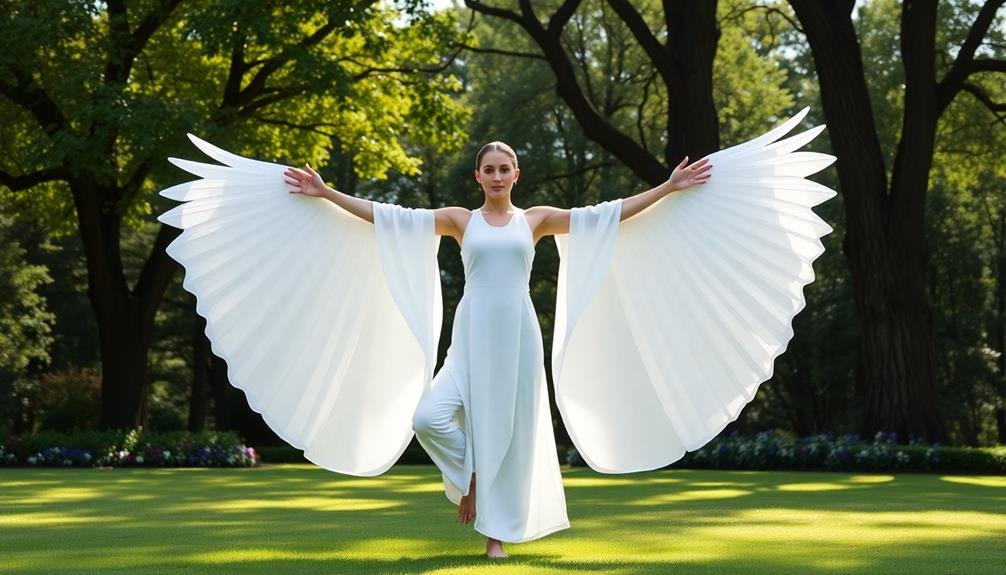
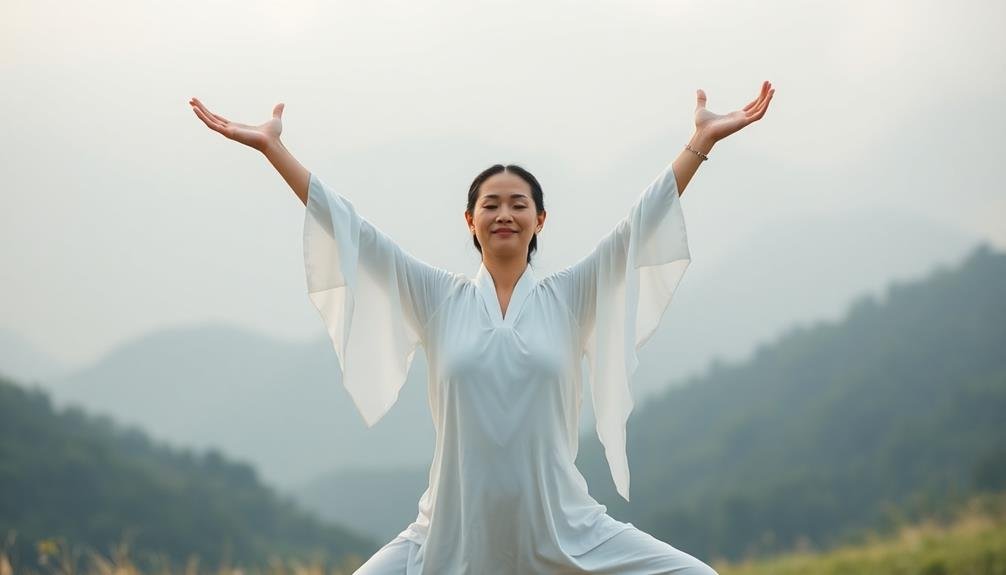
Imagine a graceful crane extending its wings as you perform this soothing Qigong move. "White Crane Spreads Its Wings" is a gentle yet powerful exercise that can help release tension in your shoulders, neck, and upper back.
Begin by standing with your feet shoulder-width apart and your arms relaxed at your sides. As you inhale deeply, slowly raise your arms out to the sides, palms facing down. When your arms reach shoulder height, rotate your palms to face up and continue lifting until your fingertips point towards the sky.
Hold this position for a moment, feeling the stretch in your chest and shoulders. As you exhale, gradually lower your arms back to your sides, reversing the palm rotation.
Repeat this movement 8-10 times, focusing on your breath and the sensation of opening your chest and stretching your arms. This exercise not only improves flexibility and posture but also promotes a sense of calm and balance.
Embracing the Moon
To perform "Embracing the Moon," you'll stand with feet shoulder-width apart, slowly raise your arms in a circular motion, and bring your hands together as if cradling a large ball.
This gentle movement can help calm your mind and release tension in your shoulders and upper back.
You can adapt this move by performing it seated or varying the speed to suit your energy levels and stress-relief needs.
Technique and Proper Form
Serenity begins with proper form in the "Embracing the Moon" Qigong move. Stand with your feet shoulder-width apart, knees slightly bent, and your arms relaxed at your sides. As you inhale deeply, raise your arms slowly, palms facing up, until they're at shoulder height. Imagine you're cradling a large, luminous moon between your hands.
To perfect your technique, focus on these key elements:
- Keep your shoulders relaxed and down
- Maintain a straight spine
- Breathe deeply and slowly from your diaphragm
- Visualize energy flowing through your arms
- Move with grace and intention
As you exhale, gently lower your arms, turning your palms to face the ground. Feel the stress melting away as you guide the moon's energy down through your body.
Repeat this flowing motion 8-10 times, synchronizing your breath with each movement. Remember, it's not about speed but about mindfulness and connecting with your body's energy.
With practice, you'll find this simple yet powerful move can quickly center you and wash away daily stressors.
Benefits for Stress Relief
The gentle motion of "Embracing the Moon" offers a wealth of stress-relieving benefits. As you practice this Qigong move, you'll notice an immediate calming effect on your mind and body. The slow, deliberate movements help lower your heart rate and blood pressure, promoting a sense of relaxation throughout your system.
By focusing on your breath and the fluid motions, you'll shift your attention away from stressors and into the present moment. This mindfulness aspect of "Embracing the Moon" can greatly reduce anxiety and racing thoughts.
The gentle stretching involved in this move also helps release physical tension, particularly in your shoulders, neck, and upper back—areas where many people hold stress.
Regular practice of this Qigong technique can improve your overall stress resilience. You'll find yourself better equipped to handle daily pressures as you develop a stronger mind-body connection.
The meditative quality of the movement can enhance your emotional balance, leaving you feeling more centered and grounded. Additionally, the improved circulation and energy flow from "Embracing the Moon" can boost your mood and increase your overall sense of well-being.
Variations and Adaptations
While "Embracing the Moon" is a powerful Qigong move on its own, you can explore several variations and adaptations to suit your needs and preferences.
These modifications allow you to customize your practice and target specific areas of tension or stress.
One popular variation involves incorporating gentle twists as you raise and lower your arms. This adds a spinal rotation element, enhancing the move's effectiveness for releasing back tension.
Another adaptation focuses on breath work, synchronizing your inhales and exhales with the arm movements for deeper relaxation.
For those with limited mobility, you can perform "Embracing the Moon" while seated, making it accessible to all fitness levels.
If you're looking to increase the intensity, try holding the top position for a few breaths before lowering your arms.
Here are some key variations to contemplate:
- Standing with a wider stance for better balance
- Adding a gentle backbend at the peak of the movement
- Incorporating wrist and finger stretches
- Performing the move with eyes closed for enhanced mindfulness
- Using visualization techniques, imagining stress leaving your body
Swimming Dragon
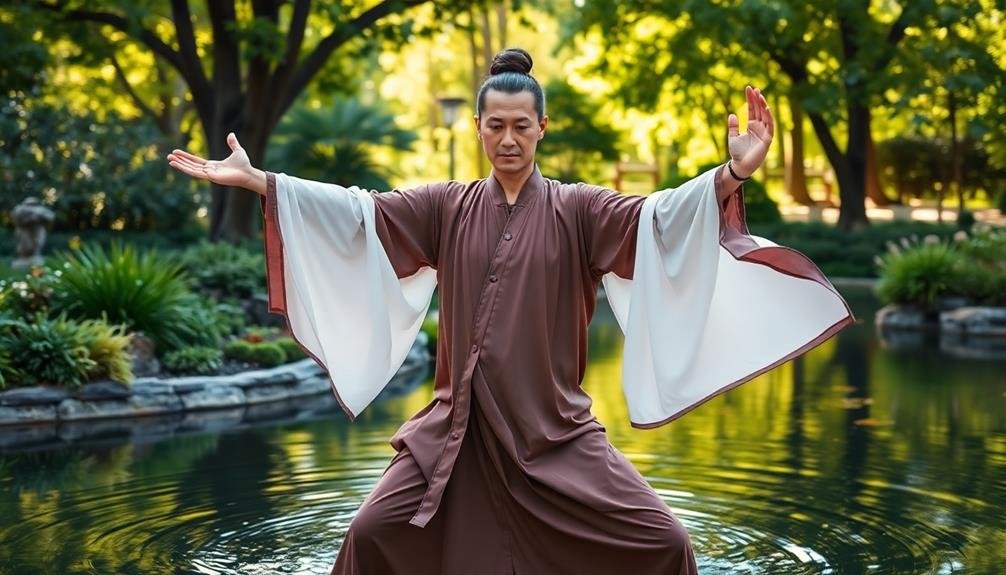
Swimming Dragon glides into the domain of Qigong as a graceful and fluid movement that mimics the undulating motion of a dragon swimming through water. This dynamic exercise engages your entire body, promoting flexibility, balance, and stress relief.
To perform Swimming Dragon, start by standing with your feet shoulder-width apart. Begin with a gentle sway, shifting your weight from side to side. As you sway, let your arms flow freely, alternating between rising and falling. Imagine you're gliding through water, allowing your spine to undulate like a dragon's body.
As you continue, incorporate breath work. Inhale deeply as you rise, exhale as you lower. This rhythmic breathing helps oxygenate your body and calm your mind. You'll feel tension melting away as you move fluidly.
Swimming Dragon isn't just about physical movement; it's a meditative practice. Focus on the sensation of energy flowing through your body. Visualize stress and negative emotions being washed away with each undulating motion.
This exercise can be particularly effective in releasing shoulder and neck tension, areas where we often hold stress.
Smiling Heart Meditation
From the flowing movements of Swimming Dragon, we now turn our attention inward with the Smiling Heart Meditation. This gentle practice focuses on cultivating inner peace and positive emotions.
You'll sit comfortably, close your eyes, and direct your attention to your heart center.
Begin by imagining a warm, radiant light in your chest. As you breathe deeply, visualize this light expanding with each inhale. Picture it filling your entire body with a sense of joy and tranquility.
Next, bring to mind things that make you smile—loved ones, happy memories, or beautiful scenes in nature.
Here's a quick guide to practicing Smiling Heart Meditation:
- Find a quiet space and sit comfortably
- Close your eyes and focus on your breath
- Visualize a warm light in your heart center
- Recall positive memories or images
- Allow feelings of joy to spread throughout your body
As you continue this practice, you'll notice a shift in your emotional state. Stress and tension will begin to melt away, replaced by a sense of inner calm and contentment.
The Smiling Heart Meditation is a powerful tool for managing everyday stress and cultivating a positive outlook on life.
Lotus Rises Through Water
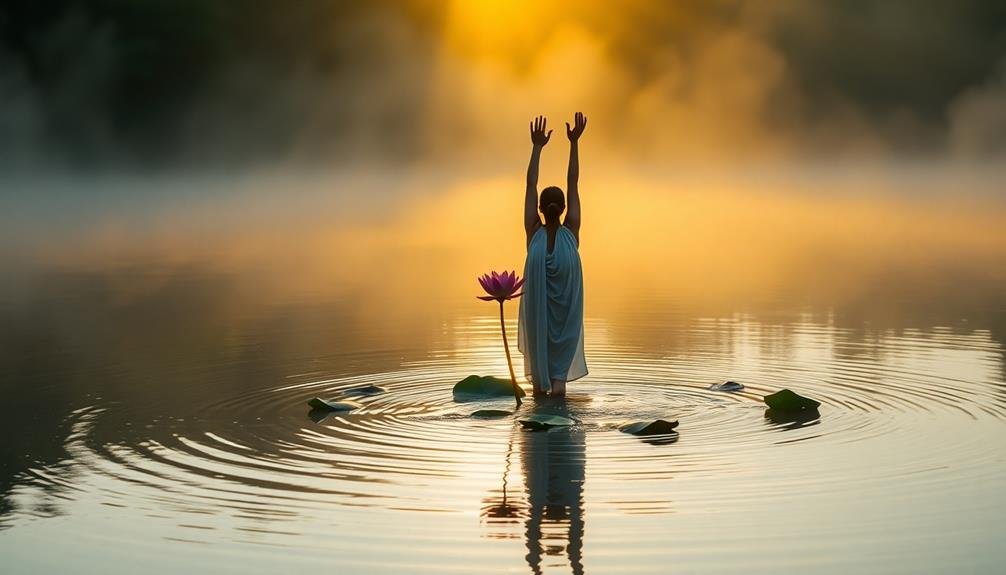
After the inward focus of Smiling Heart Meditation, we'll now explore the graceful "Lotus Rises Through Water" movement.
This dynamic exercise combines controlled breathing with flowing arm motions to release tension and cultivate energy.
Begin by standing with your feet shoulder-width apart, knees slightly bent. As you inhale deeply, slowly raise your arms from your sides, palms facing up. Imagine you're a lotus flower emerging from still water.
Continue lifting your arms until your hands meet above your head, forming a lotus bud shape. Hold this position briefly, feeling the stretch in your spine and shoulders.
As you exhale, gradually lower your arms, turning your palms downward. Picture the lotus petals opening as your hands descend. Let your fingers brush past your face and chest, continuing down to your abdomen.
Pause here, focusing on the sensation of energy gathering in your lower belly.
Repeat this sequence 5-10 times, synchronizing your breath with the movement. You'll notice increased flexibility, improved circulation, and a sense of calm washing over you.
"Lotus Rises Through Water" helps release upper body tension and promotes a feeling of lightness and renewal.
Five Elements Qigong
As we shift to more dynamic movements, let's explore the Five Elements Qigong. This practice is rooted in Traditional Chinese Medicine and corresponds to the five elements: Wood, Fire, Earth, Metal, and Water. Each element is associated with specific organs and emotions, making this qigong sequence particularly effective for balancing your body and mind.
To perform the Five Elements Qigong, you'll move through a series of flowing gestures that represent each element. Start with your feet shoulder-width apart and knees slightly bent. As you progress through the sequence, focus on your breath and visualize the energy of each element flowing through your body.
Here's a brief overview of the movements:
- Wood: Raise your arms like a growing tree
- Fire: Circulate your hands in front of your heart
- Earth: Make a circle with your arms, representing the planet
- Metal: Push your palms outward, as if cutting through metal
- Water: Flow your arms in wave-like motions
Practice this sequence daily to harmonize your energy, reduce stress, and improve your overall well-being.
You'll likely notice increased flexibility, better emotional balance, and a deeper connection to nature's rhythms.
Golden Ball of Light

Let's plunge into the Golden Ball of Light qigong exercise, a powerful technique for cultivating and directing healing energy.
Begin by standing with your feet shoulder-width apart, knees slightly bent. Relax your shoulders and close your eyes. Imagine a golden ball of light forming between your palms as you hold them about chest-height, facing each other.
Feel the warmth and energy emanating from this ball. Slowly move your hands apart, expanding the ball, then bring them back together, compressing it. As you do this, focus on your breath, inhaling as you expand and exhaling as you compress. Visualize the golden light growing brighter and more intense with each cycle.
Now, imagine this healing energy flowing throughout your body. Direct it to any areas of tension or discomfort. You can move the ball around your body, using it to "wash away" stress and negative emotions.
As you practice, you'll likely feel a tingling sensation or warmth in your hands and body. This is the qi energy flowing and balancing within you, helping to melt away everyday stress and restore your inner calm.
Frequently Asked Questions
How Long Should I Practice Qigong Daily for Stress Relief?
You'll benefit from practicing qigong for 15-30 minutes daily for stress relief. Start with shorter sessions and gradually increase. Consistency is key, so find a time that works for you and stick to it. You'll notice improvements soon.
Can Qigong Help With Specific Health Conditions Besides Stress?
Yes, qigong can help with various health conditions. You'll find it beneficial for improving balance, flexibility, and circulation. It's also known to boost immune function, reduce chronic pain, and support cardiovascular health. Try it for overall wellness.
Is It Necessary to Learn Qigong From a Certified Instructor?
While it's not strictly necessary, learning from a certified instructor can be beneficial. You'll gain proper form, guidance, and safety tips. However, you can start with online resources or books if you're comfortable self-learning. Choose what suits you best.
Are There Any Age Restrictions for Practicing Qigong?
You'll find that qigong doesn't have age restrictions. It's suitable for people of all ages, from children to seniors. You can start at any time in your life and adapt the practice to your physical abilities and needs.
Can Qigong Be Combined With Other Stress-Relief Techniques or Exercises?
Yes, you can combine qigong with other stress-relief techniques. It pairs well with meditation, yoga, and breathing exercises. You'll find that incorporating qigong into your existing routine enhances overall relaxation and stress management benefits.
In Summary
You've now explored several powerful qigong moves to melt away everyday stress. Whether you're standing like a tree or shaking it, these practices will help you find balance and calm. Remember, consistency is key. Try incorporating one or two of these moves into your daily routine. As you practice, you'll notice your stress levels decreasing and your overall well-being improving. Don't hesitate to experiment and find what works best for you.