
Origami, the Japanese art of paper folding, offers more than just beautiful creations—it's a powerful stress-relief tool. When you engage in origami, you're practicing mindfulness, focusing on the present moment and letting go of distracting thoughts. The tactile experience and repetitive actions can induce a meditative state, promoting calm and clarity. Origami also boosts cognitive skills, enhances creativity, and fosters patience. It's portable, allowing you to manage anxiety on the go, and can easily be incorporated into daily routines. By folding paper, you're not just creating art; you're nurturing your mental well-being. Discover how this ancient practice can transform your stress management techniques.
The Art of Mindful Folding

How can a simple act of folding paper become a gateway to mindfulness? Origami, the Japanese art of paper folding, offers a unique opportunity to engage in a meditative practice that calms your mind and sharpens your focus.
As you fold each crease with precision, you're forced to concentrate on the present moment, letting go of distracting thoughts and worries. The process of creating an origami figure requires your full attention.
You'll find yourself immersed in the tactile sensation of the paper, the visual patterns forming before your eyes, and the gentle sounds of paper bending. This sensory experience anchors you firmly in the here and now.
As you progress through each step, you're practicing patience and persistence. You'll learn to embrace imperfections and celebrate small victories.
The repetitive nature of folding can induce a state of flow, where time seems to stand still and your mind achieves a sense of calm clarity.
Origami's Meditative Properties
Origami's meditative properties extend far beyond the simple act of folding paper. As you engage in this ancient art form, you'll find yourself entering a state of focused concentration, similar to traditional meditation practices. The repetitive motions and precise folds required in origami naturally guide your mind into a calm, centered state.
When you immerse yourself in origami, you're practicing mindfulness without even realizing it. You'll become acutely aware of the present moment, focusing on the tactile sensations of the paper and the visual intricacies of each fold. This heightened awareness can help reduce stress and anxiety, allowing you to temporarily disconnect from daily worries.
| Meditative Aspect | Benefit | Technique |
|---|---|---|
| Focused attention | Reduces mental chatter | Concentrate on each fold |
| Rhythmic breathing | Promotes relaxation | Sync breath with folding |
| Present-moment awareness | Decreases anxiety | Observe paper texture |
Origami's meditative properties also foster patience and self-compassion. As you work through complex designs, you'll learn to embrace imperfections and celebrate small victories. This mindset can translate into other areas of your life, helping you approach challenges with a calmer, more balanced perspective. By regularly practicing origami, you're not just creating beautiful paper art—you're cultivating a more peaceful, centered state of mind.
Tactile Engagement and Sensory Focus
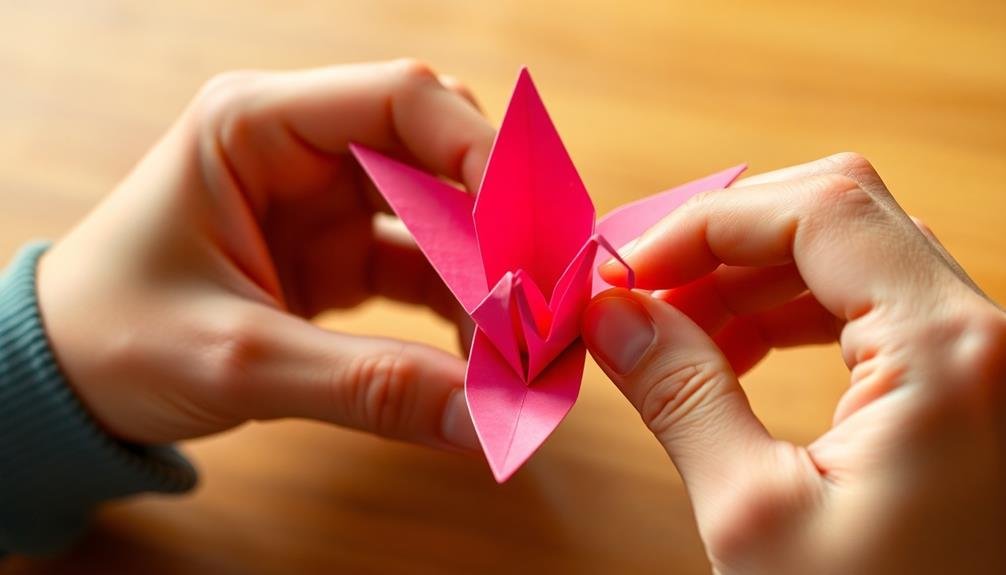
Three key senses are engaged when you practice origami: touch, sight, and proprioception. As you fold paper, you're fully immersed in a tactile experience that demands your attention and focus. Your fingertips become acutely aware of the paper's texture, thickness, and resistance as you manipulate it into intricate shapes.
Your visual sense is equally stimulated as you observe the paper's transformation. You're constantly evaluating angles, aligning edges, and visualizing the next steps in the folding process. This intense visual engagement helps to quiet your mind and redirect your thoughts away from daily stressors.
Proprioception, your body's sense of position and movement, comes into play as you make precise folds and adjustments. This heightened awareness of your hands' movements can be deeply grounding and centering.
Imagine the sensory experience of origami:
- The crisp sound of paper being creased
- The subtle resistance felt when making a tight fold
- The visual satisfaction of seeing symmetrical shapes emerge
- The tactile pleasure of running your fingers along a smooth, folded edge
This multi-sensory engagement is what makes origami such a powerful stress-relieving activity, allowing you to fully immerse yourself in the present moment.
Achieving Flow State Through Origami
Have you ever lost track of time while engrossed in a task? That's the essence of flow state, a psychological phenomenon where you're fully immersed in an activity, feeling energized focus and enjoyment. Origami can be an excellent gateway to achieving this state.
When you're folding paper, you're engaged in a series of precise, repetitive actions that require your full attention. As you progress through the steps of creating a model, you'll find yourself becoming increasingly absorbed in the process. The outside world fades away, and your focus narrows to the paper in your hands.
This state of flow isn't just enjoyable; it's beneficial for your mental health. It reduces stress, boosts creativity, and improves overall well-being. By regularly practicing origami, you're training your brain to enter this state more easily, potentially carrying over to other areas of your life.
To achieve flow through origami, start with models that match your skill level. As you improve, gradually increase the complexity. You'll find that the challenge of more intricate folds keeps you engaged and in the flow state for longer periods.
Boost in Self-Esteem and Confidence
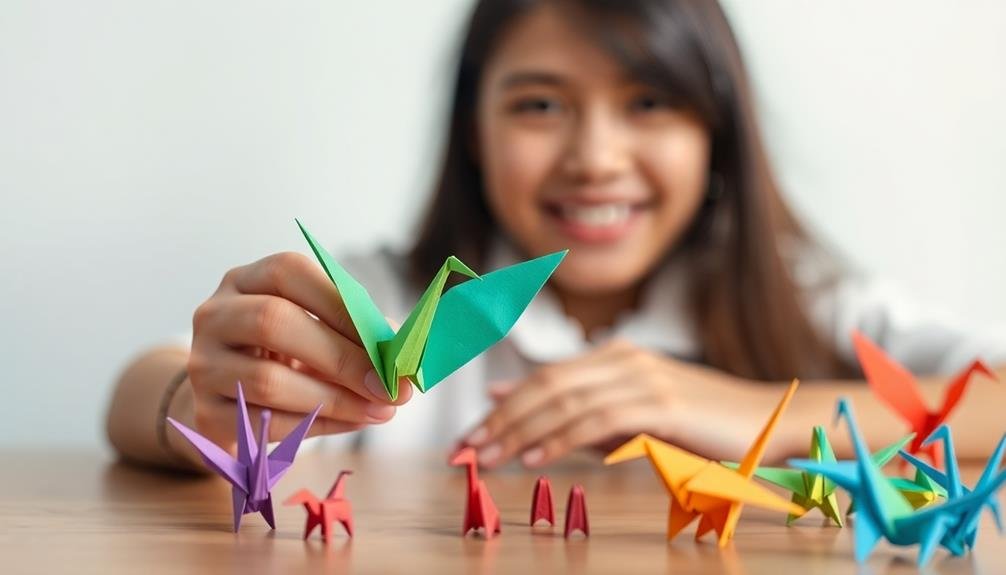
You'll experience a tangible sense of accomplishment when you complete an origami project, boosting your self-esteem.
As you master new folding techniques and create increasingly complex designs, your confidence in your abilities will grow.
This newfound self-assurance often extends beyond origami, positively impacting other areas of your life.
Tangible Accomplishment Feeling
How often do we get to hold our accomplishments in our hands? With origami, you can do just that. As you fold and shape paper into intricate designs, you're creating tangible evidence of your skills and patience. This physical representation of your efforts provides a unique sense of achievement that's often missing in our digital world.
When you complete an origami project, you'll experience:
- The weight of the paper creation in your palm
- The crisp edges and precise folds under your fingertips
- The visual impact of colors and patterns coming together
- The satisfying symmetry of the final form
This tactile experience reinforces your sense of accomplishment, making it more concrete and memorable. You can display your creations, give them as gifts, or simply admire them as reminders of your capabilities. Each finished piece serves as a demonstration of your growing skills and perseverance.
Moreover, the tangible nature of origami allows you to track your progress over time. As you tackle more complex designs, you'll have physical proof of your improvement, further boosting your confidence and motivation to continue learning and creating.
Mastering New Skills
Mastery breeds confidence, and origami offers a perfect playground for skill development. As you progress from simple designs to more complex ones, you'll notice a boost in your self-esteem. Each successful fold reinforces your ability to learn and execute new techniques, gradually building your confidence.
You'll find yourself tackling increasingly challenging projects, pushing your boundaries and expanding your skillset. This process of continuous improvement enhances your problem-solving abilities and spatial reasoning. As you master new folding techniques, you're not just creating paper art; you're developing patience, precision, and perseverance.
The satisfaction of completing a difficult origami model can greatly impact your self-perception. You'll start to see yourself as someone capable of overcoming obstacles and achieving goals. This newfound confidence often spills over into other areas of your life, encouraging you to take on new challenges with enthusiasm.
Moreover, origami's versatility allows you to explore various styles and techniques, keeping your learning journey fresh and exciting. You'll discover that there's always something new to master, fueling your desire for continuous growth and improvement.
Origami as a Grounding Technique
When you're feeling anxious or overwhelmed, origami can serve as an effective grounding technique.
As you fold the paper, you're compelled to focus on the present moment, shifting your attention away from worries.
This physical-mental connection practice helps calm your mind and body, anchoring you to the here and now.
Focusing on Present Moment
In the hustle of daily life, finding moments of calm can be challenging. Origami offers a unique way to focus on the present moment, pulling your attention away from worries and distractions. As you fold paper, your mind naturally shifts to the task at hand, creating a meditative state that's both relaxing and engaging.
When you're immersed in origami, you're fully present with:
- The texture of the paper between your fingers
- The crisp sound of each fold
- The gradual emergence of a shape from a flat sheet
- The satisfaction of completing each step in the process
This intense focus on the present moment helps quiet the mind's chatter, reducing stress and anxiety. You'll find that your breathing naturally slows and your muscles relax as you concentrate on the intricate folds.
Origami forces you to slow down, pay attention to details, and approach each step with patience. It's a form of mindfulness practice that doesn't require sitting still or closing your eyes, making it accessible even to those who struggle with traditional meditation techniques.
Physical-Mental Connection Practice
Origami's ability to ground you in the present moment extends beyond mental focus, offering a powerful physical-mental connection practice. As you fold paper, you're engaging in a tactile experience that bridges the gap between your thoughts and actions. This connection helps anchor your mind to your body, creating a sense of unity and presence.
The precise movements required in origami activate your fine motor skills, enhancing your body awareness. You'll feel the texture of the paper, the pressure of your fingertips, and the subtle shifts in your hand positions. This heightened sensory experience draws your attention away from mental chatter and into the physical domain.
Moreover, origami serves as a form of embodied cognition, where your physical actions directly influence your mental state. As you manipulate the paper, you're not just creating a shape; you're physically manifesting your thoughts and intentions. This process reinforces the mind-body connection, helping you feel more grounded and centered.
Stress Reduction Through Repetitive Motions

The gentle, repetitive motions of origami offer a soothing balm for a stressed mind. As you fold and crease paper, you'll find your thoughts slowing down and your focus narrowing to the task at hand. This repetitive action triggers a meditative state, similar to the effects of activities like knitting or coloring.
When you engage in origami, you're creating a rhythm that can lower your heart rate and blood pressure. The predictable patterns of folding paper activate the parasympathetic nervous system, which helps counteract the body's stress response.
You'll likely notice your breathing becoming slower and more regular as you work.
To visualize the stress-reducing effects of origami, imagine:
- Your tense muscles gradually relaxing with each fold
- Worries floating away like paper boats on a stream
- A wave of calm washing over you as you complete each step
- Your mind clearing like a blank sheet of paper
Cultivating Patience and Perseverance
When you take on complex origami projects, you'll find yourself developing patience and perseverance.
As you work through intricate folding techniques, you'll learn to embrace the slow progress and resist the urge for instant gratification.
Mastering Complex Folding Techniques
Mastering origami's complex folding techniques demands more than just nimble fingers. It requires a keen eye for detail, spatial awareness, and the ability to visualize three-dimensional forms from flat paper. As you progress in your origami journey, you'll encounter increasingly intricate designs that challenge your skills and push your boundaries.
To master complex folding techniques, you'll need to:
- Study diagrams meticulously, paying close attention to each step and fold direction
- Practice precision folding, ensuring crisp creases and accurate alignments
- Develop patience for repetitive actions, as some models require hundreds of folds
- Learn to manipulate paper in new ways, such as wet-folding or creating curved surfaces
You'll find yourself working with various paper types, from delicate tissue to sturdy cardstock, each presenting unique challenges. As you tackle more advanced models, you'll discover techniques like inside reverse folds, rabbit ear folds, and sink folds.
These methods allow you to create intricate details and lifelike features in your origami creations. With persistence and practice, you'll transform flat sheets into complex, three-dimensional works of art, revealing a world of creative possibilities.
Embracing Slow Progress
Embracing slow progress in origami is essential for cultivating patience and perseverance. As you practice this art form, you'll quickly realize that mastery doesn't come overnight. Each fold, crease, and shape requires time and dedication to perfect.
When you're working on a complex model, you might find yourself struggling with a particular step for days or even weeks. Don't get discouraged; this is where the true value of origami shines. It teaches you to appreciate small victories and incremental improvements.
You'll learn to celebrate the slight adjustments in your technique that lead to cleaner folds or more precise creases.
Origami also helps you develop a growth mindset. As you tackle increasingly difficult projects, you'll build resilience and problem-solving skills. You'll learn to view mistakes as learning opportunities rather than failures.
This patient approach to progress can spill over into other areas of your life, helping you tackle challenges with a calmer, more methodical mindset. Remember, the journey is just as important as the final product in origami, so embrace the slow, steady path to improvement.
Overcoming Frustration Mindfully
Frustration can be a paper tiger in the world of origami, appearing insurmountable but ultimately conquerable with the right mindset.
As you navigate the intricate folds and creases, you'll inevitably encounter moments of difficulty. It's essential to approach these challenges with mindfulness and patience.
When frustration arises, take a deep breath and remind yourself that it's part of the learning process. Embrace the opportunity to cultivate perseverance.
Instead of giving up, try these mindful approaches:
- Pause and observe your emotions without judgment
- Gently unfold your work and start again with fresh eyes
- Break down complex steps into smaller, manageable tasks
- Celebrate small victories along the way
Social Connections in Paper Art
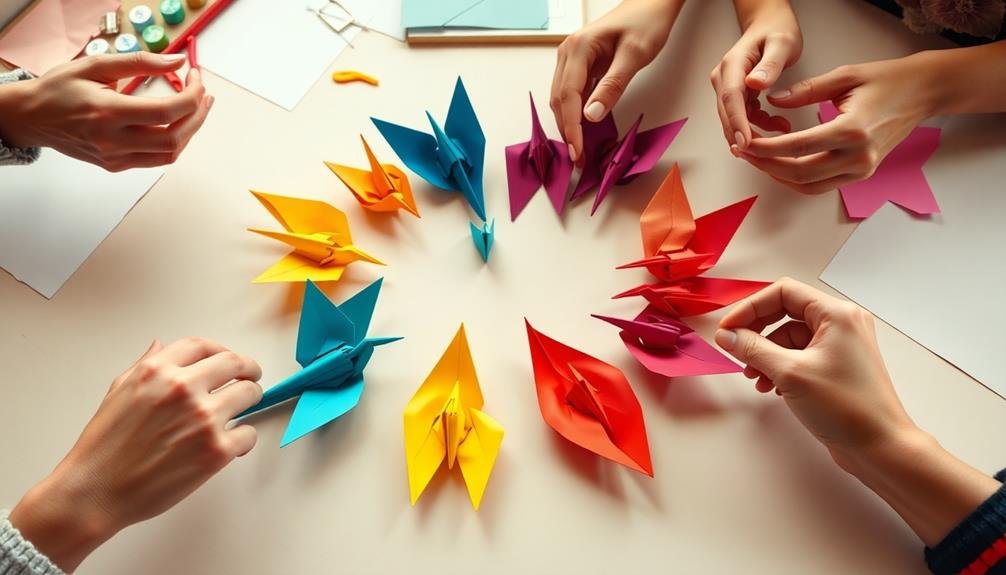
Through the art of origami, people forge unexpected social connections. You'll find that paper folding often brings together individuals from diverse backgrounds, ages, and skill levels.
As you attend origami workshops or join local clubs, you're likely to meet others who share your passion for this intricate art form.
Online communities dedicated to origami offer a platform for you to connect with enthusiasts worldwide. You can share your creations, exchange tips, and learn new techniques from fellow folders.
These virtual spaces foster a sense of belonging and mutual appreciation for the craft.
Collaborative origami projects can strengthen existing relationships and create new ones. Whether you're working on a large-scale installation with a group or teaching a friend how to fold their first crane, you're building bonds through shared experiences and creative problem-solving.
Origami also serves as an excellent icebreaker in social settings. You can impress others with your folding skills or use simple models to engage in conversations and spark interest in the art form.
This unique hobby provides you with endless opportunities to connect with others and expand your social circle.
Creative Expression and Emotional Release
Folding paper into intricate shapes offers you a powerful outlet for creative expression and emotional release. As you manipulate the paper, you're free to explore your artistic side without the pressure of perfection. This process allows you to channel your emotions, whether positive or negative, into a tangible creation.
The act of folding can be meditative, helping you focus on the present moment and temporarily escape from daily stressors. As you progress in your origami skills, you'll find yourself tackling more complex designs, boosting your confidence and sense of accomplishment.
Origami provides a unique way to visualize your emotions:
- Angry? Create sharp, angular forms like a fierce dragon
- Calm? Fold gentle curves of a peaceful swan
- Excited? Craft a vibrant, multi-layered flower
- Nostalgic? Shape a simple childhood favorite, like a paper airplane
Through origami, you're not just creating art; you're engaging in a form of emotional self-care. The repetitive motions and focus required can help regulate your mood and provide a sense of control.
Cognitive Benefits of Paper Folding

Paper folding isn't just a creative hobby; it's a workout for your brain. When you engage in origami, you're stimulating multiple cognitive functions simultaneously. You're enhancing your spatial awareness as you visualize and manipulate 2D shapes into 3D forms. This process strengthens your ability to understand and interpret visual information, a skill that's essential in fields like architecture and engineering.
As you follow origami instructions, you're improving your concentration and memory. You're learning to focus on step-by-step processes, which can boost your problem-solving skills and attention to detail. These benefits extend beyond paper folding, potentially improving your performance in work and daily tasks.
Origami also develops your hand-eye coordination and fine motor skills. As you make precise folds and creases, you're training your hands to work in harmony with your visual perception. This can be particularly beneficial for children's development and for maintaining dexterity in older adults.
Moreover, the mathematical principles inherent in origami can enhance your understanding of geometry and symmetry. You're unconsciously working with concepts like fractions, angles, and proportions, making origami an engaging way to reinforce mathematical thinking.
Origami's Portability for Anxiety Management
Origami's portability makes it an excellent tool for managing anxiety on the go. You can easily carry a few sheets of paper in your bag or pocket, ready to fold whenever you need a moment of calm. Unlike other stress-relief methods that require specific equipment or environments, origami can be practiced almost anywhere.
When anxiety strikes, you can quickly engage in the soothing act of paper folding. This portability allows you to:
- Create a miniature origami crane while waiting for a stressful job interview.
- Fold a simple boat during a turbulent flight to distract yourself.
- Make a paper flower in a crowded subway to find a moment of peace.
- Craft a jumping frog during a tense family gathering to lighten the mood.
The act of folding paper demands your full attention, effectively pulling your mind away from anxious thoughts. As you focus on the intricate folds and precise movements, you'll find your breathing naturally slows and your muscles relax.
This portable anxiety management technique empowers you to take control of your mental state, regardless of your surroundings.
Incorporating Origami Into Daily Routines
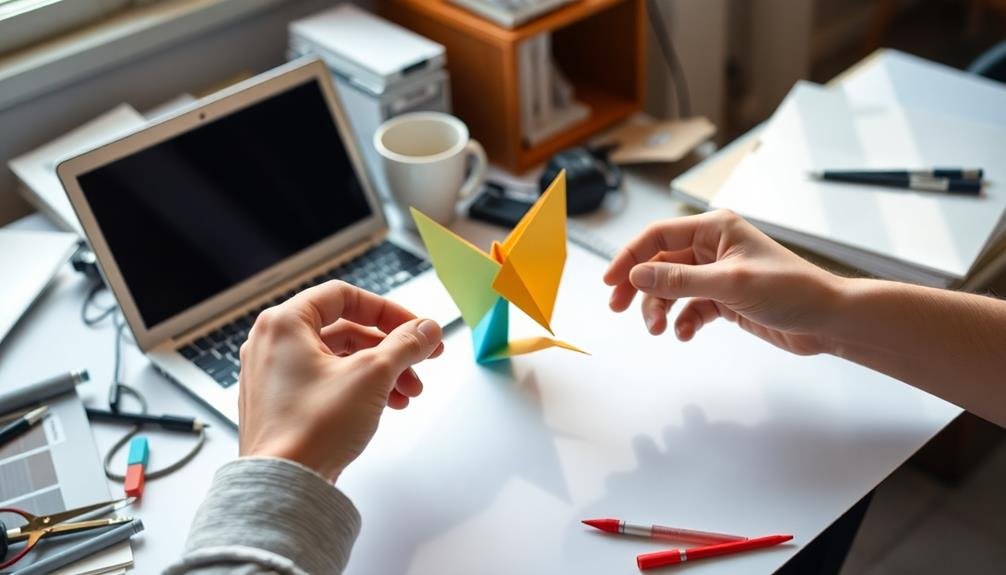
Many people find that integrating origami into their daily routines can greatly enhance their overall well-being. You can start by setting aside a few minutes each day to fold a simple model. This practice can help you cultivate mindfulness and reduce stress. Try folding during your morning coffee break or as a wind-down activity before bed.
To make origami a consistent part of your routine, consider these ideas:
| Time of Day | Origami Activity |
|---|---|
| Morning | Fold a lotus flower |
| Lunchtime | Create paper animals |
| Afternoon | Make modular origami |
| Evening | Fold relaxing shapes |
You can also use origami to mark special occasions or celebrate milestones. For example, fold a crane for each day of a 30-day challenge or create paper decorations for holidays. By incorporating origami into your daily life, you'll not only improve your folding skills but also reap the mental health benefits of this ancient art form. Remember, consistency is key, so start with small, achievable goals and gradually increase your origami practice as it becomes a natural part of your routine.
Frequently Asked Questions
Can Origami Help With Specific Mental Health Conditions Like Depression or PTSD?
Origami can potentially help with depression and PTSD. You'll find it's a calming, meditative practice that improves focus and mindfulness. It can boost your mood, reduce anxiety, and provide a sense of accomplishment, which may alleviate symptoms.
Are There Any Potential Negative Effects of Practicing Origami Regularly?
You might experience some negative effects from regular origami practice. You could strain your eyes, develop repetitive stress injuries in your hands, or become frustrated if you're too perfectionist. It's important to take breaks and practice moderation.
How Long Does It Take to See Stress-Relief Benefits From Origami?
You'll likely experience stress relief from origami within your first session. As you practice regularly, you'll notice more significant benefits over weeks or months. It's a personal journey, so you may feel the effects differently than others.
Can Origami Be Used as a Complementary Therapy Alongside Traditional Mental Health Treatments?
Yes, you can use origami as a complementary therapy alongside traditional mental health treatments. It's a mindful activity that can help you focus, reduce anxiety, and improve your mood. You'll find it's a calming and creative outlet.
Are There Age Restrictions for Benefiting From Origami's Stress-Relieving Properties?
You'll find origami's stress-relieving benefits aren't restricted by age. Whether you're a child or senior, you can enjoy its calming effects. It's a versatile activity that adapts to your skill level, making it accessible for everyone.
In Summary
You've discovered origami's stress-relieving power. By engaging in this mindful art, you're not just folding paper; you're calming your mind, boosting your confidence, and sharpening your cognitive skills. It's a portable, accessible way to manage anxiety and express creativity. Whether you're a beginner or an expert, incorporating origami into your daily routine can provide a peaceful respite from life's stresses. So pick up a sheet of paper and start folding your way to tranquility.




Leave a Reply